AI
AEO Isn't SEO's Sequel. It's a Different Game on the Same Field
AEO (Answer Engine Optimization) and SEO (Search Engine Optimization) are two sides of the same coin
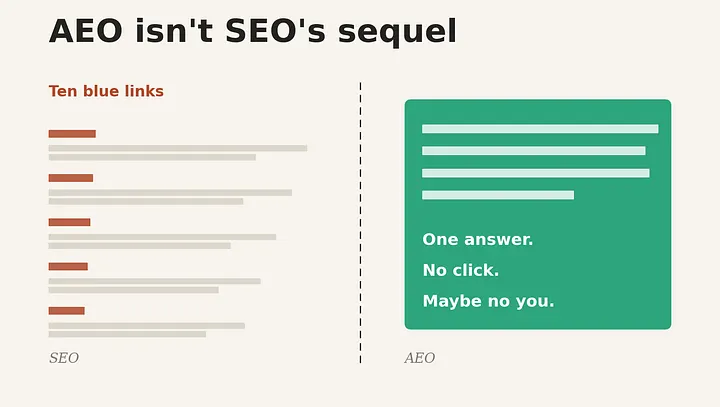
Every briefing on AI search lands on the same reassuring note. AEO (Answer Engine Optimization) and SEO (Search Engine Optimization) are two sides of the same coin. Do both. They reinforce each other. Keep your content team doing what it was already doing, maybe bolt on a few FAQ sections, and move on.
That framing is popular because it asks nothing of anyone. No tradeoffs, no reallocation, no uncomfortable conversation about who owns what. For anyone actually responsible for a content budget, though, it's incomplete in a way that eventually shows up as a line item nobody can explain.
Here's the less comfortable version. SEO and AEO optimize for two different ways of consuming information, and those ways are starting to pull apart. Knowing where they diverge, not just repeating that they "complement" each other, is what separates a content strategy that still makes sense in a year from one that quietly stops working while every dashboard keeps looking fine.
The data behind the divergence
The numbers aren't subtle, though the picture moves faster than most briefings can keep up with. On the SEO side, click-through rates got squeezed hard wherever an AI Overview showed up. Seer Interactive's 2026 study, covering 53 brands and 5.47 million tracked queries, found organic CTR on AI Overview queries dropped 61% at its low point, and the number one organic result lost roughly 79% of its clicks under the same conditions according to Ahrefs. But Seer's own follow-up data shows that decline bottomed out in December 2025 at 1.3% and rebounded 85% to 2.4% by February 2026. Seer's researchers are now warning against treating the original 61% figure as a stable trend line. The honest summary is that organic CTR took a real hit, the size of that hit is still being revised, and "AI Overviews permanently destroy organic clicks" is a less settled claim than it sounded a year ago.
On the AEO side, the curve runs the other way. A widely cited figure from Superprompt's 2025 traffic study claims AI-referred sessions across 400+ websites grew 527% in five months, from around 17,000 to over 107,000 between January and May 2025. That stat is worth flagging on its own, more on that below. The more durable number comes from Conductor, an established enterprise SEO platform, whose benchmarks put AI referral traffic at roughly 1% of total sessions, with ChatGPT sending the large majority of it. ChatGPT alone reportedly sends more referral traffic to the open web than Reddit or LinkedIn, per Ahrefs.
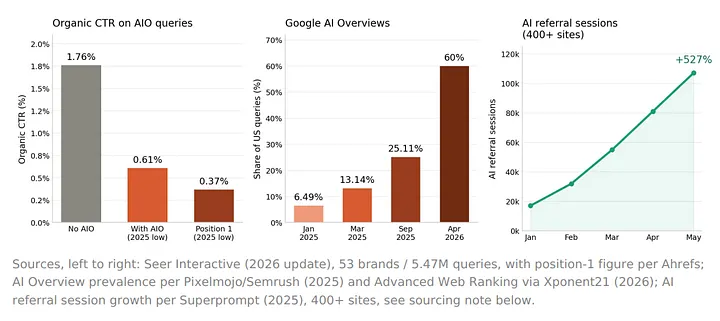
The middle chart there is worth sitting with on its own. AI Overviews went from a feature you might occasionally see to a feature present on the majority of US Google searches in a little over a year. This isn't a niche behavior shift anymore. It's becoming the default way Google answers a search, even if the downstream effect on clicks is more complicated than a single number suggests.
Two things are true here, and most briefings only mention one of them. AI referral traffic is still tiny in absolute terms, around 1% of total sessions per Conductor. But the trajectory, however exactly you measure it, is unlike anything organic search has produced in years, compounding from a base that barely existed three years ago.
Put these side by side and the picture is hard to miss. One surface is under real pressure even if the exact size of the dent is being revised. The other is expanding from a small base. Neither story is settled, and that's the point: this is a live, fast-moving dataset, not a fixed backdrop you can cite once and build a five-year plan on.
So you've got a shrinking surface and a fast-growing one that's currently small. Both of those facts are real at the same time. Neither cancels the other out. And here's the part the "they complement each other" framing skips entirely: the content structure that performs well on one surface isn't automatically the structure that performs well on the other. Sometimes it's the opposite.
What SEO actually rewards
SEO rewards engagement after the click. Google's ranking systems favor pages that earn dwell time, attract backlinks, satisfy a search intent thoroughly enough that the visitor doesn't bounce back to the results, and build topical depth across a cluster of related pages. The deal was always: rank well, get the click, then hold the visitor's attention long enough to convert.
That deal produced a familiar shape of content. Long pages. Broad coverage of a topic, often padded with context and examples that double as authority signals and as bait for adjacent queries. Internal links pulling the visitor deeper into the site. A structure that builds toward the answer rather than leading with it, because for years, leading with the answer in the first paragraph meant giving the visitor a reason to leave before they'd scrolled at all.
None of that was a mistake. It was a rational response to how the algorithm and the reader actually behaved for two decades.
What AEO actually rewards
AEO rewards something close to the opposite: getting picked up without a click happening at all. An answer engine, whether that's ChatGPT, Perplexity, Gemini, an AI Overview, or Claude, is trying to assemble a direct response to someone's question, and it's scanning the web for the cleanest, most self-contained chunk of information it can lift and attribute. It doesn't care about your internal link structure or how long a human would linger on your page. It wants something it can extract in isolation and quote with confidence.
That favors a different shape entirely. Short, direct statements. Answers placed up front, no wind-up. Specific numbers instead of hedged generalities. Writing that holds up as a fragment, because a fragment is exactly how it's going to be read, sitting next to fragments pulled from your competitors, with the reader never seeing your page at all.
A quick note on the alphabet soup
If you've been reading around this topic, you've probably also run into GEO and AIO, and you're entitled to ask whether those are different things you now need to worry about too.
Short answer: not really, and the fact that they exist at all tells you something useful about where this space is.
GEO, Generative Engine Optimization, comes mostly from an academic paper out of Princeton and a handful of research groups, and it's been picked up by some vendors as their preferred term. In practice it describes the same thing this article calls AEO: structuring content so generative AI systems can extract and cite it.
AIO, AI Optimization, is even looser. Some people use it as a catch-all for anything AI-related in marketing, others use it specifically for optimizing toward Google's AI Overviews.
There's no governing body here, no W3C for AI search terminology, so different consultants and platforms settled on different names for largely overlapping ideas, the same way "growth hacking" and "performance marketing" described a lot of the same work a decade ago. This piece sticks with AEO because it's the term with the clearest lineage from existing SEO practice, which fits the argument we're making: this is a discipline growing out of SEO, not arriving from nowhere.
That said, the differences aren't always purely cosmetic. Some practitioners do use GEO specifically for the academic framing, optimizing for citation in generative model outputs broadly, versus AEO for the more SEO-adjacent, practitioner-driven version focused on Google's ecosystem and answer engines like Perplexity. If you're building a vocabulary for your team, it's worth picking one term and defining it clearly rather than trying to map all four onto a single rigid taxonomy that doesn't really exist yet. We'll dig into where these terms genuinely diverge, and where they're just rebrands, in a follow-up piece.
Where the two genuinely pull against each other
If SEO and AEO were just different flavors of "good content," none of this would be worth writing about. The tension is real because some of what helps one actively hurts the other.
Take dwell time. A page built to maximize time on page, through narrative setup, embedded video, related-content modules, multi-step walkthroughs, is exactly the kind of page an answer engine struggles to extract from. The information it wants is buried in paragraph six, wrapped in qualifiers, surrounded by stuff that exists for engagement rather than clarity. Push harder on the SEO version of that page and you can make it less citable, not more.
Now flip it. A page built around tight 50-to-80-word answer blocks, factual, no hedging, no story, is exactly what an answer engine wants. But it's also a page that gives a human almost no reason to keep scrolling, click into related content, or spend the kind of time on page that SEO signals reward. You've made something easy to cite and easy to leave.
There's a third tension that's quieter but matters just as much: control. With SEO, however messy the ranking, the person who clicks ends up on your page, in your framing, next to your calls to action. With AEO, your content gets paraphrased by someone else's model and shown alongside, or blended with, your competitors' content, with no guarantee the framing or the attribution or even the accuracy of the summary matches what you actually wrote. You're putting effort into content you no longer control the presentation of.
None of this makes SEO and AEO enemies. It does mean "do both" isn't a strategy. It's a description of the problem. The real question is how you produce content that serves both ways of consuming information without each one slowly undermining the other.
The fix: two artifacts, one source of truth
The practical answer taking shape, and the one with actual implications for how content teams are staffed, is that a single topic now needs two distinct pieces of writing, not one.
The first is the long-form page, the SEO asset. This is where authority gets built, where internal linking happens, where the story, the examples, the brand voice, and the path to conversion all live. It's written for a person who arrived via search and is deciding whether to trust you.
The second is what people are starting to call an answer capsule: a short, self-contained block that answers one specific question directly, with no preamble, no hedging, and no reliance on anything else on the page. It can sit inside the long-form page, often right after a heading, but it has to be written as though it'll be pulled out and read completely on its own, because that's exactly what an answer engine is going to do with it.
This isn't "add an FAQ section" with a new name on it, although an FAQ is one place a capsule can live. What changes is how it's written: specific numbers instead of vague claims, a complete thought instead of something that leans on "as mentioned above," and zero assumption that the reader has seen anything else.
That raises a real staffing question. Writing two pieces per topic, one for narrative and authority, one for extraction and citation, is more work than writing one. If it just gets dropped on content marketing as extra, unfunded work, it'll get done badly or skipped. Some teams are folding it into SEO's existing scope, since answer capsules also tend to win featured snippets, so it's not purely additive effort. Others are treating AI visibility as closer to a brand or PR function, because of what actually seems to drive citations in the first place, which brings us to the next point.
What actually drives citations, and it's not mostly your page
Here's the finding that should change where some of this budget goes. The strongest predictor of whether your content gets cited in an AI Overview isn't how well you've optimized your own page. It's how often your brand gets mentioned elsewhere. Ahrefs found a 0.664 correlation between how often a brand is mentioned across the web and how often it shows up in AI Overviews. Separately, sites with more than 32,000 referring domains were 3.5 times more likely to get cited by ChatGPT than sites with fewer.
This is the AEO equivalent of the old backlink graph, except it's not really about links anymore. It's about how consistently your brand, your data, and your claims appear across the rest of the web, including places you don't control: industry roundups, comparison sites, forums, Wikipedia, third-party review platforms. Answer engines seem to weigh corroboration, does this claim show up consistently from independent sources, right alongside how extractable any single page is.
For an executive, that means AEO isn't something you can fully solve from inside your CMS. Part of it is a digital PR problem, with budget and ownership questions that sit outside the content team entirely.
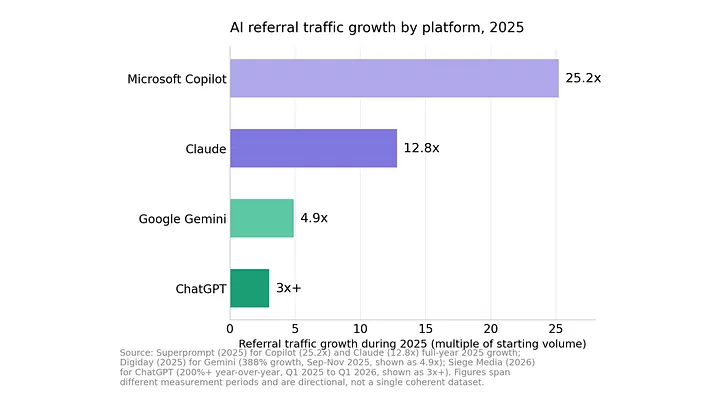
Also worth flagging here: ChatGPT still sends the large majority of AI referral traffic today, but it isn't the fastest grower. Copilot and Claude grew faster off smaller bases during 2025, and Gemini isn't far behind. A content or visibility strategy built only around what gets ChatGPT to cite you may already be out of date by the time it's fully rolled out. Whatever "optimize for AI citations" means in your organization, it has to mean optimizing for more than one engine, because the ranking of which engines matter most is still moving.
What to actually do with your next planning cycle
A few things follow from all this, stated plainly enough to act on.
Don't shift SEO budget to AEO based on current traffic. AEO traffic is still around 1% of sessions, and a reallocation justified on today's numbers won't survive a hard question from finance. The case has to be made on trajectory and on the risk of being invisible on a fast-growing surface, not on current return, because current return on AEO specifically is close to unmeasurable with most analytics tools.
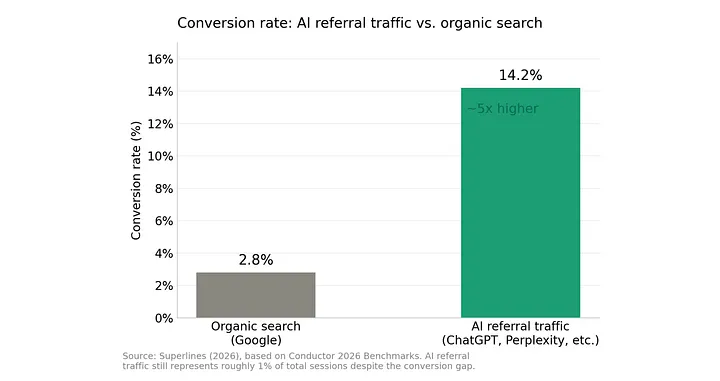
That said, if you're looking for the closest thing to an ROI argument, this is it. The conversion rate on the AI referral traffic that does arrive is reportedly around five times higher than organic search. The honest caveat is the same one as before: this is based on early, relatively small samples, and the explanation may simply be that today's AI-referred visitors have already done their research elsewhere and arrive ready to act, which is a different population than the average organic searcher. Whether that ratio holds as AI referral volume scales up is genuinely unknown. Use this number to argue for not ignoring the channel, not to build a revenue projection.
Don't treat answer capsules as a content-team afterthought. They're new writing, held to a different standard, competing for the same writer hours as everything else. Either fund them explicitly or expect them not to happen.
Don't assume your existing SEO pages are neutral when it comes to AEO. Pages built for dwell time might be working against you on extractability. Going through your highest-value pages, not for keyword performance but for whether an AI model could lift a clean, accurate, complete answer from each one in isolation, will probably surface gaps your normal SEO audit never would.
And don't ignore the external piece. If getting cited correlates more strongly with how often you're mentioned across the web than with how your own page is built, then some of next year's content budget might be better spent getting accurately represented on the sites answer engines already trust. That's a different team, a different skill set, and a different set of relationships than your SEO function currently has.
A note on sources, and on how reliable this data actually is
Given the subject of this article, it felt wrong to cite numbers without saying where they came from and how much weight each one can bear. Treating sourcing as an afterthought is exactly the habit that's filling the AI search space with numbers nobody can trace back to anything.
Seer Interactive is a digital marketing agency that has been running a longitudinal study of AI Overview impact on organic CTR since mid-2024, now in its third major iteration (April 2026), covering 53 brands, 5.47 million tracked queries, and 2.43 billion organic impressions. It's the most methodologically transparent source in this space: they publish their dataset size, their limitations (they're explicit that they can't prove causation, only correlation), and they've revised their own conclusions publicly when new data complicated the original story. The 61% CTR drop and the subsequent 85% rebound both come from Seer, which is part of why this article treats the CTR story as unsettled rather than as a fixed number.
Ahrefs is an SEO tooling company with one of the largest independent web crawl indexes, which makes their position-1 CTR and referral-traffic comparisons (such as ChatGPT versus Reddit and LinkedIn) reasonably credible: they're measuring from their own crawl data rather than aggregating other people's claims.
Conductor is an enterprise SEO and content platform that publishes periodic benchmark reports based on data from its client base. The 1% AI-referral-traffic figure and the 87.4% ChatGPT share both come from Conductor's 2026 benchmarks. It's vendor data, so it reflects Conductor's customer base rather than the whole web, but Conductor's primary business isn't selling AI-visibility tools, which makes it less likely to be inflated for marketing purposes than some of the other sources in this space.
Superprompt is the source of the 527% AI referral traffic growth figure, which is probably the single most-repeated stat in every "AEO statistics 2026" roundup published this year, including some of the ones used elsewhere in this piece. It's worth being direct about this one: Superprompt is a vendor selling AI-visibility tracking tools, the 527% figure originates from their own self-published study, and the same number appears recycled across dozens of SEO blogs that cite each other rather than the original methodology. None of that means the number is wrong. It does mean it hasn't been independently verified the way the Seer or Ahrefs figures have, and it should be read as "a vendor says AI referral traffic grew dramatically in 2025," not as an audited industry statistic. This article kept the figure because the direction (steep growth from a near-zero base) is corroborated by Conductor's independent numbers, even if the precise 527% shouldn't be treated as load-bearing.
The broader point, and it's a fitting one to end on: if you're going to build a budget case on any of these numbers, go to the primary source, check the publication date, and check whether a more recent version of the same study has already revised the figure. Several of the stats circulating in late 2025 were already out of date by the time they made it into a roundup article in early 2026. That's not a reason to avoid the topic. It's a reason to footnote carefully.
So no, AEO and SEO don't simply complement each other. They're two different games sharing a field, and right now most organizations have only fielded a team for one of them.