AI
AI Does Not Remember.
One of the most persistent misunderstandings about modern AI systems is the idea that they remember previous conversations. They don't!
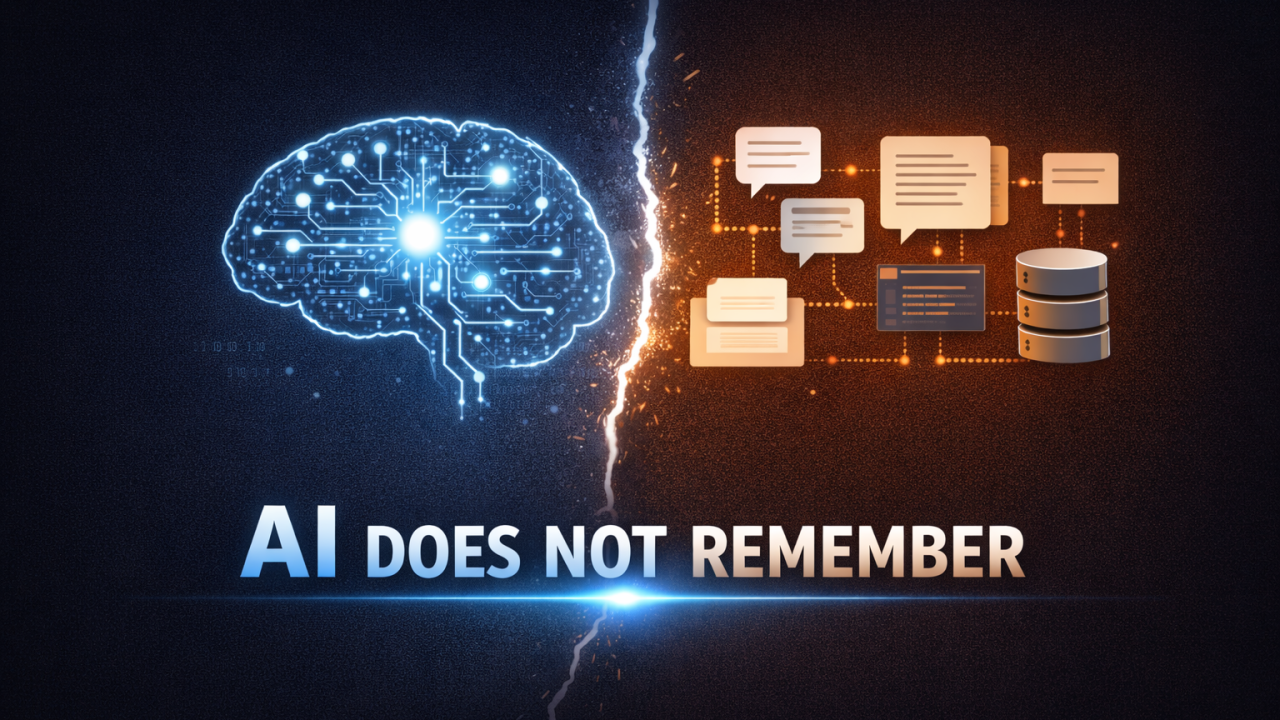
It Reconstructs, and That Changes How We Should Design Systems.
One of the most persistent misunderstandings about modern AI systems is the idea that they remember previous conversations.
They don't.
What looks like memory is, in reality, a carefully engineered illusion created by repeatedly re-sending past context to a stateless model and asking it to reason over that context again.
This distinction is not philosophical. It is architectural. And it has very real consequences for how we design production systems.
As engineers and platform architects, we should stop thinking in terms of AI memory and start thinking in terms of context reconstruction.
The fundamental property: LLMs are stateless
Large Language Models (LLMs) such as GPT-4.x, GPT-4o, or GPT-5.x are, by design, stateless.
A single request is evaluated as:
output = f(model, input_tokens)
There is no internal persistence layer. No evolving conversation object. No session state.
Once the response is produced, the model immediately "forgets" everything about that interaction.
From the model's perspective, the next request is indistinguishable from the first, unless you explicitly send information again.
Where the "memory" illusion comes from
In chat applications, what actually happens is surprisingly simple. Every time the user sends a new message, the backend service reconstructs the full conversational context:
- System prompt
- Developer instructions
- Previous user messages
- Previous assistant responses
- Tool outputs
- Retrieved documents
All of this is concatenated and re-sent as a new prompt. The model does not remember the conversation. It re-reads it. Every single time.
The apparent continuity comes from prompt replay, not from internal memory.
The practical mechanism
In real production architectures, especially in enterprise systems, this usually looks like the following:
Conversation history is stored externally (database, cache, vector store, CRM object, message log, etc.).
For each new turn:
- The backend fetches relevant history
- Optionally summarizes or trims it
- Optionally enriches it with retrieved knowledge
- Rebuilds a prompt
- Sends it to the model
The model only sees what fits into the current context window.
Why this matters more than people realize
From a system-design perspective, this has several deep implications.
1. Memory is not free
Every additional message you "remember" consumes tokens. Long conversations are expensive:
- Higher latency
- Higher cost
- Higher risk of truncation
- Higher chance of instruction drift
When your chatbot suddenly "forgets" an earlier constraint, it is often not because the model failed. It is because your orchestration layer dropped, trimmed, or summarized that context.
2. The model does not know what is important
The model has no built-in notion of long-term relevance. If you send several previous messages, the model does not know which one is a business rule, a casual greeting, or a legal or contractual constraint.
…unless you structure that information explicitly.
This is why production systems must clearly separate and organize:
- Conversational flow
- Operational constraints
- System policies
- Tool instructions
- Business rules
and inject them into different layers of the prompt.
3. "Long-term memory" is an application problem, not a model feature
When people say:
"We need long-term memory for our AI agent."
What they actually mean is:
We need a retrieval and context-assembly strategy.
Real memory in today's AI systems is implemented through databases, vector search, semantic indexing, summarization pipelines, state machines, conversation graphs, and others.
The model itself is only the reasoning engine at the end of that pipeline.
Why this is especially important in enterprise platforms such as Salesforce
In enterprise environments, for example, when integrating LLMs with CRM workflows, case handling, pricing engines, or automation, this architectural detail becomes critical.
Consider a real support assistant:
- A user opens a case
- The assistant asks diagnostic questions
- Product metadata is fetched
- Business rules are evaluated in Apex
- Multiple tool calls are executed
- Follow-up questions depend on previous answers
The model cannot "remember" any of this.
If your orchestration layer does not explicitly re-inject the previous answers, the extracted entities, the intermediate results, and the decisions already made, the model will happily contradict itself. Because, from its point of view, none of those steps ever happened.
This is why robust AI solutions inside platforms such as Salesforce must treat the LLM as a reasoning component operating over a reconstructed state, not as a conversational brain with continuity.
Security and data visibility: the model sees what the platform is allowed to see, not what the user sees
There is another subtle but critical implication when using LLMs inside platforms such as Salesforce.
Salesforce itself can technically read far more data than the end user is allowed to see.
A backend service, an Apex class, or an integration user may have access to fields hidden by Field-Level Security, records restricted by sharing rules, objects not visible to the user's profile, internal or administrative metadata.
If your AI orchestration layer simply queries data in system context and forwards it to the model, the assistant may reason over information that the user is not authorized to access.
The model does not understand Salesforce security. It cannot interpret:
- Sharing rules
- Role hierarchies
- Permission sets
- Field-level security
- Record visibility
In enterprise AI systems, data security must become a first-class layer of the AI architecture.
In practice, this requires an explicit security-aware data layer that:
- Evaluates record-level access for the current user
- Enforces field-level visibility
- Applies object and feature permissions
- Filters or redacts sensitive attributes before context assembly
Only after this filtering should information be injected into the prompt.
In other words, the AI experience must be built on top of the same authorization model as the platform itself.
Otherwise, you do not have an AI assistant.
You have a data-leak pipeline with a conversational interface.
Why the illusion is so convincing
The illusion works because LLMs are extremely good at:
- Reconstructing narrative coherence
- Inferring missing context
- Maintaining stylistic and logical continuity
- Summarizing and compressing information
If you re-send the conversation, the model can appear to "remember" in a very human way. Technically, however, this is much closer to "re-reading a conversation transcript before replying" than to remembering an experience.
This also explains hallucinations and drift
As conversations grow and older context is trimmed, summarized, or reordered, subtle changes occur:
- Constraints are paraphrased
- Edge cases disappear
- Earlier assumptions are lost
- Tool outputs are shortened
From the model's perspective, the world has changed. So the answer changes. This is not an inconsistency in the model. It is an inconsistency in the reconstructed context.
A more accurate way to describe modern AI systems
A more precise description of today's AI assistants would be:
A stateless probabilistic reasoning engine operating over a dynamically assembled context window.
That is very different from:
A conversational agent with memory.
The design mindset we should adopt
If you are building AI-driven features, especially inside enterprise systems, your architecture should explicitly include:
- A conversation store
- A state model
- A decision memory
- A retrieval strategy
- A context-assembly layer
and a strict separation between business logic, system constraints, and conversational flow.
The LLM should be one component in your architecture, not the place where state lives.
Final thought
AI does not remember. It re-processes.
The continuity you experience is created by software engineers, not by the model.
Understanding this changes how you design reliability, security, explainability, cost control, and long-term behavior.
In practice, the real intelligence of modern AI systems is not only in the model. It is in the orchestration layer that decides what the model is allowed to see, every single time.