AI
The most important sales conversation now happens without you
In complex, high-trust selling, the buyer's first decision is no longer "which vendor." It is "who is even worth a conversation." And that one is increasingly made inside an AI, before your team hears a thing.
There is a moment in every serious sale that used to belong to your team, and it has quietly slipped out of reach. Before a buyer fills out a form, before a rep lands a meeting, before anyone signs, the buyer has already decided who is worth their time. For a fast-growing share of them, that decision now starts with a question typed into a chat window.
It is easy to wave this off if you sell something serious. Technical products, long evaluations, real budgets, procurement, the kind of purchase nobody makes on a whim. Surely the chatbot crowd is somebody else's problem. I assumed the same thing, until I sat with the numbers.
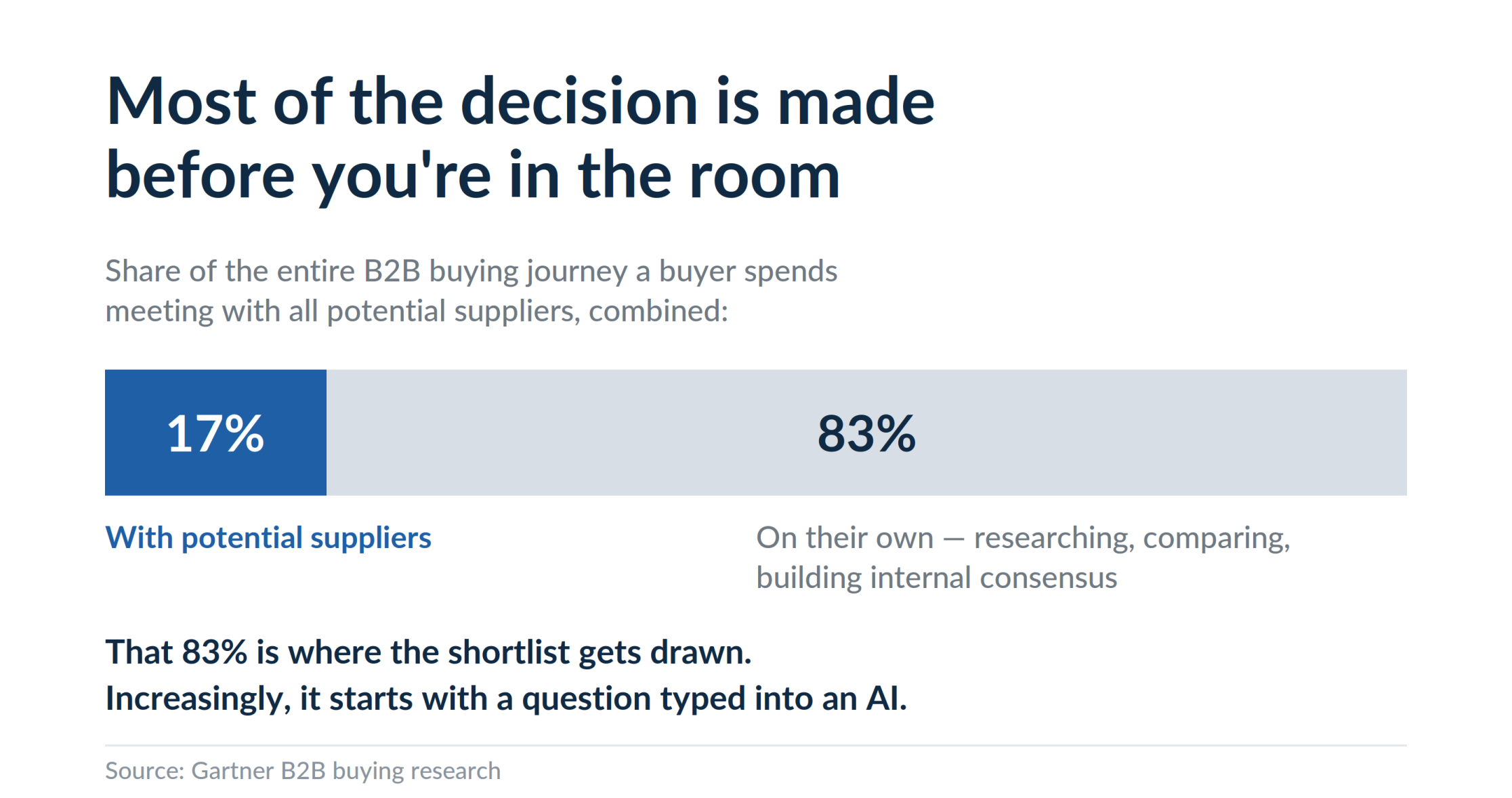
Gartner has spent years tracking how business buyers actually spend their time, and one figure should stop you cold. Across the entire buying journey, buyers spend only about 17% of it meeting with potential suppliers. When they are weighing several vendors at once, any single one of you gets maybe five or six percent of their attention. Everything else, more than eighty percent of the journey, happens somewhere you are not. Researching. Comparing. Arguing internally about what they actually need.
That much was already true before AI arrived. What changed is where that eighty percent now begins. It begins with an assistant. In Gartner's most recent buyer survey, 45% said they used generative AI in their last purchase, mostly to research vendors and products. Forrester, sampling roughly eighteen thousand buyers, found that AI has become the single source buyers most often call meaningful, ahead of vendor websites, ahead of analysts, ahead of sales reps. Almost all of them now touch it somewhere in the process.
- 45% used generative AI in their last purchase, mainly to research vendors and products (Gartner, 2025)
- 94% of B2B buyers now use AI somewhere in the buying process (Forrester, 2026)
- 13 + 9 stakeholders inside and outside the company in a typical buying decision (Forrester)
So the first list of who is even worth evaluating is being drawn by a model, often by a junior engineer or a newly assigned evaluator who does not yet know the field and takes the AI's framing at face value. If your name is not in that answer, none of your real strengths get a turn. You do not lose the deal. You are simply never considered for it.
Here is where the hype gets it wrong. AI is not closing these deals. Nobody commits a team to a multiyear platform, or signs a serious license, because a chatbot sounded enthusiastic. The long part of your sale still decides the outcome: the demos, the proof of concept, the technical scrutiny, the trust your people earn over quarters. Forrester found that 69% of buyers who lean on AI go straight back to a human to verify what it told them, and more than sixty percent run some kind of trial before they commit. The rep still matters enormously. The rep just matters later. What AI has taken over is the front door. It decides who gets to have the long conversation at all.
And here is the part I find genuinely uncomfortable. The companies showing up first in these answers are not always the best ones. They are the ones who understood that being excellent and being findable stopped being the same thing. Plenty of strong, established names, the ones with the deepest engineering and the longest track record, are still letting the work speak for itself, the way it always used to. The model has never heard them speak. It cites the competitor who wrote the clearer explainer, published the sharper comparison, and showed up in the places the model learned from.
There is a second risk sitting underneath that one. When the AI does mention you, it is often wrong. It credits you with a capability you retired, or one you never had. It blends you with a competitor. In Gartner's data, 51% of buyers said they were likely to run into misleading information from generative AI. When that misleading information is about you, it is shaping the shortlist before anyone on your side gets the chance to correct it.
All of this lands harder the more complex your sale is. When a purchase pulls in a dozen or more stakeholders, a procurement team involved from day one, and a budget cycle measured in quarters, the requirements get written early, by people doing quiet research. Forrester puts the typical buying group at thirteen people inside the company and another nine outside it. If your name is missing while those requirements take shape, you are not catching up later. By the time sales gets invited in, the criteria are set, sometimes built around a competitor you should have beaten on the merits.
I do not think the answer is to panic, and I certainly do not think it is to hire the first agency promising to "rank you in ChatGPT." It starts with something cheaper and more honest. Open the tools your buyers use. Ask them about your category, your products, your competitors. Read the answers the way a customer would, not the way you wish they read. The first time I did this for a few categories I know well, the results ran from "fair enough" to "that is just not true anymore." It was a useful kind of uncomfortable.
The buyers have already changed how they decide. The open question is whether the people selling to them have noticed. The conversation about you is happening right now, with or without your input. The only real choice is whether you know what it is saying.
Sources. Gartner B2B buying research (time-allocation across the buying journey; 2026 survey of 645 B2B buyers on generative-AI use and validation behavior). Forrester, The State of Business Buying, 2026 (survey of roughly 18,000 global buyers: AI as a primary research source, buying-group size, AI adoption in the purchase process).