AI
The AI generation gap is real. It's just pointing the wrong direction.
That was the whole prompt. Eight words, no context...
I want to be careful with this one because there's a version of it that just sounds like an old guy complaining about young people, and I'm not trying to write that. But I keep running into the same thing and I want to put it somewhere.
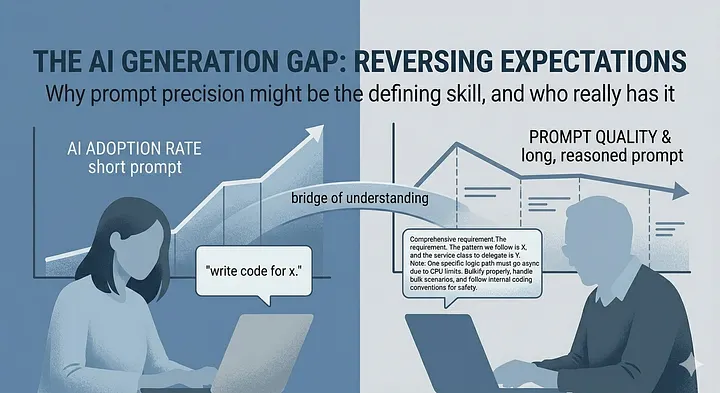
Here's what got me thinking about this. I have a friend, also a developer, maybe three years into his career. Different company than me, different stack mostly, but sometimes we share cool stuff. A few weeks ago we were on a call and he was showing me how he uses Gemini for the boring parts of his day. He pulled up a session he'd run that morning, walked me through it. His prompt was something like "write me a trigger handler for opportunity that does X."
That was the whole prompt. Eight words, no context. And what came back wasn't terrible exactly. It compiled. It would probably work on a single record. But it didn't bulkify properly, it had no idea what conventions his team follows, and it had inlined some logic that you'd really want in a service class. He told me he spent about an hour cleaning it up before he was happy with it.
Later that same week I was doing something pretty similar on my end, and I caught myself typing. My prompt was, I don't know, maybe four paragraphs. I told it the patterns we follow, I named the service class I wanted it to delegate to, I mentioned that one particular path needed to go async because of CPU limits we'd hit before. It got me about 80% of the way there on the first try.
Same tool, same model, same day. The difference wasn't really the AI doing something different. It was the prompt, which is to say it was us, the people typing.
I've been thinking about that interaction a lot, and I've been reading whatever research I can find on this, and I think there's something real here that nobody is talking about honestly. The assumption I keep hearing, at conferences, on meetings, from clients, is that Gen Z is the AI-native generation and the rest of us are catching up. I don't actually think that's true. Or it's true in a way that doesn't matter, and what does matter is moving in the opposite direction.
Yes, the adoption numbers are real
Let me concede the obvious part first. Your people use AI more than older people. It's not close. Almost 4 out of 5 Gen Z workers use these tools regularly. Half of them, according to a Built In piece from earlier this year, ask GPT before they ask their manager a question. That last stat in particular is worth sitting with for a second, because the implications for how junior staff are learning are pretty wild, but that's a different article.
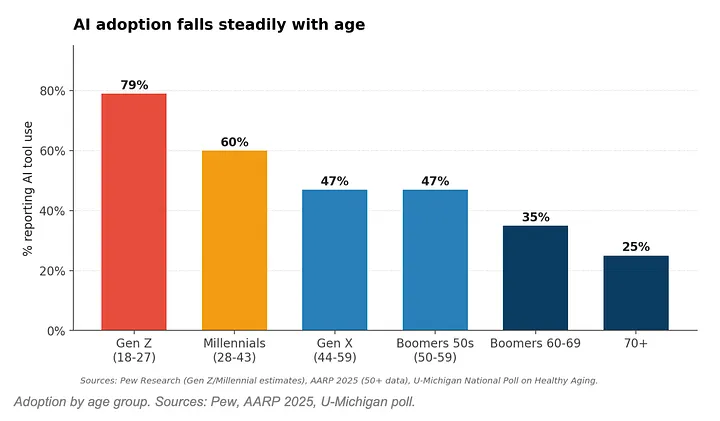
For workers over 60, it's about 1 in 4. So yes, there's a generation gap in adoption. I'm not arguing with that.
What I'm arguing with is the leap from "they use it more" to "they use it better". Those are different things, and we've gotten lazy about treating them as the same.
The reading thing
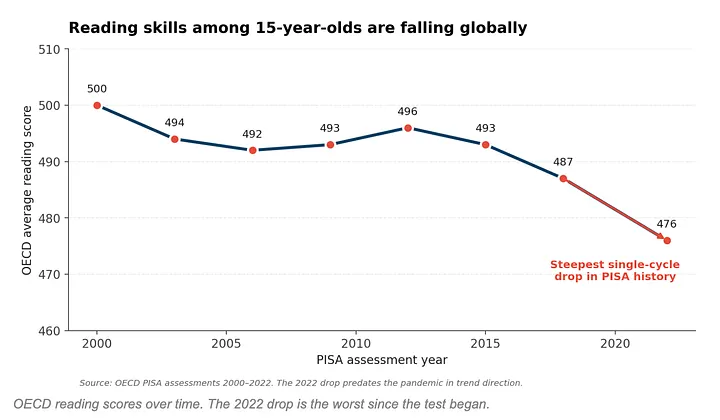
The 2022 PISA results, which test 15-year-olds across the OECD every three years, were the worst reading scores ever recorded since they started tracking this in 2000. Down 10 points on reading, 15 on math. People wrote it off as the pandemic but the slide started in 2018. PIRLS, which tests fourth-graders globally, showed the same trend. In the US, only a third of fourth-graders read at grade level. A Pepperdine literature professor said in an interview that her undergrads aren't struggling to think critically about texts. They're struggling to read sentences.
There's also some data on IQ, which is even more surprising. For about a hundred years, IQ scores in developed countries kept going up, somewhere around 2 to 3 points every decade. That trend has flattened out, and in some places it's reversed. Norway has good data on this because they test young people when they sign up for service, so they have decades of records to compare. The most recent generations are scoring a bit lower than the ones before, mostly on the verbal and reasoning parts.
I want to be careful here because I know how this can sound. I'm not saying young people aren't smart. They are. I work with sharp young developers all the time, and a lot of them run circles around me on things I'll never catch up on. The point is just that the average has shifted a little, and averages matter when we're talking about how a whole group uses a tool.
And the tool we're talking about, whether it's ChatGPT or Gemini or Claude or whatever you happen to use, is something you work with entirely through reading and writing. So if reading and writing skills are softening a bit in the group that uses it the most, that's worth paying attention to.
Why this matters more for AI than for other tools
Here's something I didn't appreciate until I started using these models for real work. Prompting is a writing skill. It's not a coding skill, even when you're using it for code. The model takes your sentence as input and produces text as output. Garbage in, garbage out, but more specifically: vague in, vague out.
What makes a good prompt is the same thing that makes a good requirements doc, or a good Stack Overflow question, or a good ticket. Precise vocabulary. Enough context that the person on the other end can act on it without having to ask three follow-up questions. Patience to read the response. And the instinct, which I think is the rarest one, to push back when something feels wrong.
Cognitive scientists have a name for the bucket those skills sit in. They call it crystallized intelligence. It's the accumulated stuff. Vocabulary, semantic depth, pattern recognition you've built up over years. It works differently from fluid intelligence, which is more about raw speed.
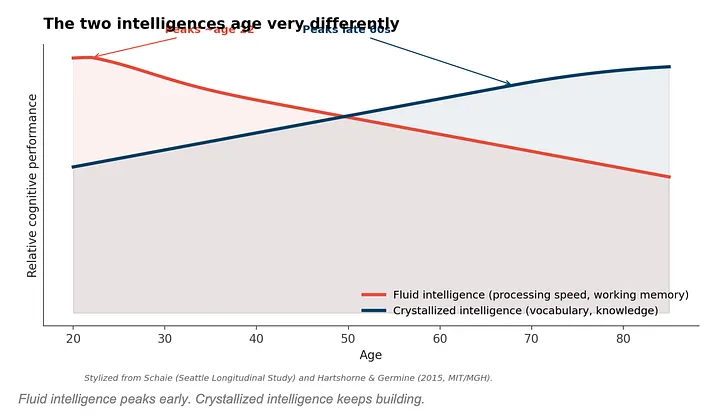
Hartshorne and Germine ran a study at MIT a few years back, with almost 50,000 participants, and found that vocabulary scores keep climbing into people's late 60s and early 70s. The Seattle Longitudinal Study, which has been running since I was in elementary school, shows similar trajectories for verbal reasoning. The textbook claim that vocab peaks at 40 turned out to be wrong, at least in modern populations where people stay in cognitively demanding jobs longer.
A 2025 paper in Intelligence (the journal) looked at nine traits linked to career success. Most of them peak between 55 and 60. Fluid intelligence drops, sure, but emotional intelligence, financial literacy, moral reasoning, resistance to sunk-cost bias, all of those keep getting sharper.
So if I'm being honest about what the data shows, here's where we end up. The skills you need to write a good prompt are getting weaker in the youngest generation, and they're at their strongest in the group that's using AI the least. It's a strange situation. And it makes the whole idea that young people are naturally better at AI look pretty thin once you actually sit with it.
It doesn't shake out the same in every job, though
I want to be fair to the other side, because the picture isn't uniform. When I started reading the productivity research, I expected one clean story. There isn't one. It really depends on the work.
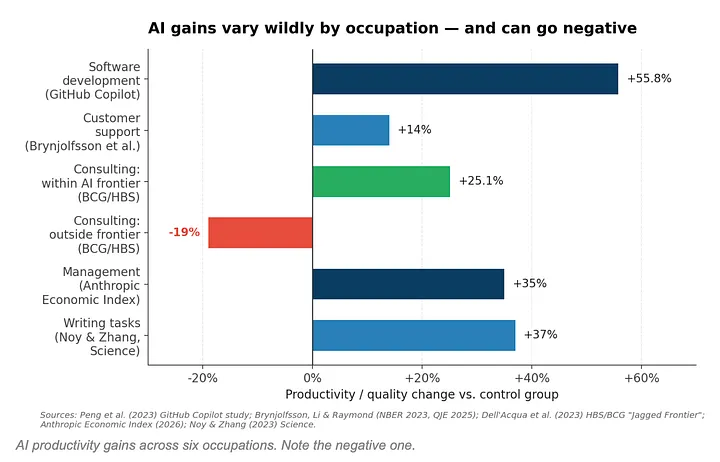
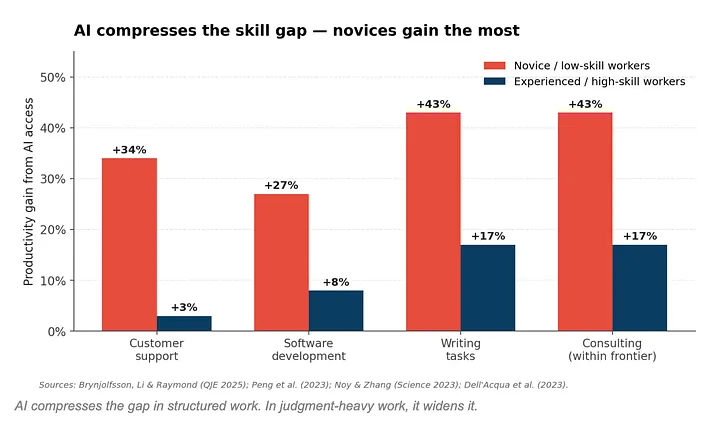
Coding. This is where young devs actually do well, and the research backs it. The GitHub Copilot study from 2023 found developers completed a benchmark coding task 55.8% faster with AI. Google's internal numbers showed a 21% time savings. Ant Group, Alibaba's fintech arm, rolled out their own coding agent and saw a 55% bump in lines of code shipped. The interesting wrinkle: junior devs gained more than seniors. At Ant Group, the senior engineers showed no statistically significant gain at all.
I see this in Salesforce land too. A junior dev with Copilot can scaffold an LWC or a batch class faster than I could have at the same career stage. The AI is, in a real sense, an experience compressor. It's handling them the patterns I would have absorbed over years of code review. Good for them, honestly. The part they still get hurt on is the choices that aren't really coding. When should this be a flow vs Apex. Why does this sharing model bite us in 18 months. Should we use Platform Events here or just async Apex. The AI doesn't help much with those, and I don't expect it to soon.
Customer service. Brynjolfsson and his coauthors followed about 5,000 support agents at a large company for a year. With AI, they resolved 14% more issues per hour on average. The breakdown was what mattered. The bottom-quartile agents improved by 34%. The top performers barely moved. Same equalizer pattern as in code. The AI is dispensing the implicit playbook the veterans had built up over years, handing it to new hires, and bringing them up to speed faster than mentorship ever did. The vets still win on the edge cases, the angry customer who's about to churn, the situation the script doesn't cover. So what's actually happening in support, I think, is that the job is splitting in two and AI plus juniors handles the routing half.
And then management and consulting, which is where it gets really interesting
There's a study from 2023 that I think more people should know about. A team out of Harvard, MIT, Warwick, and Wharton ran an experiment with BCG. They gave 758 consultants real management tasks. Some had GPT-4 access, some didn't.
Two results. On tasks the AI was actually good at, the AI group did 12% more tasks, 25% faster, and produced output rated 40% higher in quality. Huge win. On tasks that fell outside what the AI could actually handle, the AI group was 19 percentage points worse than the control. They lost to the people who didn't have AI access. The researchers called it falling asleep at the wheel. The AI produced confident, professional-sounding answers that were wrong, and the consultants didn't catch it.
That second finding is the one I keep coming back to. The skill that matters most in that kind of work isn't writing the prompt. It's reading the answer and knowing whether to trust it. And that's not really a coachable thing. That comes from having seen what good and bad solutions look like in your domain over enough years that you've internalized the patterns. Junior people don't have it yet because they haven't been around long enough to build it. That's not a criticism, it's just how time works.
Anthropic put out a study earlier this year, the Economic Index, that looked at 81,000 actual conversations people had with Claude across different jobs. Management was the occupation reporting the highest productivity gains. Higher than software engineers. BCG's own internal data shows managers using AI at almost twice the rate of frontline workers. Which surprises people, but it shouldn't, because the work managers do (synthesizing, weighing options, deciding) is exactly the work AI is best at helping with when you actually know what you're doing.
Two ways of working with these tools
If I had to summarize what I've watched in offices over the last two years, there are two distinct styles of working with AI and they barely overlap.
Style one is fast. Short prompt, scan the answer, copy what looks useful, move on. High volume, low friction, almost no verification. This is what most younger users I've worked with do. It's actually fine for low-stakes stuff. It's bad when the output is going in front of a client or into a system.
Style two is slower. Longer prompts with real context. Reading the whole response. Pushing back when something looks off. Verifying anything that matters. This is how most of the senior people I know use AI, when they bother to use it. Slower per prompt, but the output is usable as-is.
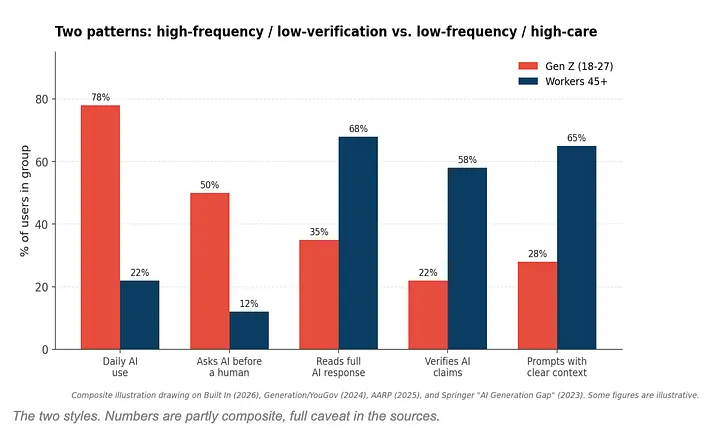
What worries me about the juniors I work with isn't that they have the fast style. It's that they only have the fast style. They learned AI as a fast tool. The slow careful style isn't a thing they're building, and by the time they hit the part of their career where the careful style is the only one that works, the habit won't be there.
Older users who do engage with AI are doing well
There's a study from Generation, this nonprofit, that surveyed 2,600 workers over 45 across five countries. The adoption rate is low, about 15% report using AI at work. But the ones who do are mostly self-taught power users. Among that group, more than half reported real improvements in work quality, productivity, and decision-making.
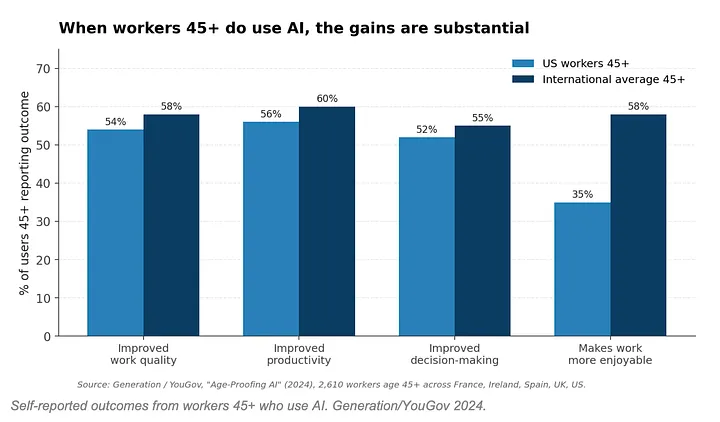
Which matches what I see anecdotally. The 50-something architect who's leaned in is often getting more out of Claude than the 25-year-old developer who's been using it daily for two years. Because the architect knows what good looks like and uses the AI to get there faster. The developer is often using it to produce something that compiles.
So who wins, then
Honestly? Neither generation, cleanly.
The easy version of this argument, the version that goes "actually old people are better at AI," is wrong. A well-read 22-year-old will out-prompt a careless 55-year-old every single time. Plenty of senior people I know are AI-allergic in a way that costs them. Plenty of juniors are sharper than their managers. I'm not trying to flip the stereotype.
What I'm trying to say is that the story isn't really about age. It's about a particular skill profile. Precise language, the patience to read carefully, deep pattern matching in a specific domain, and the instinct to verify before you trust. Those things happen to cluster more reliably in people over 40 today, not because being older makes you smarter, but because that cohort was educated when long-form reading was the default mode of consuming information, and they've spent two or three decades building domain depth in real jobs with real consequences.
The most useful AI users I've met combine the volume and fearlessness of the younger style with the precision and verification habits of the older one. That combination is rare. It's also hireable.
If you run a team, I'd push back on the assumption that you know who needs AI training. Hire and develop for the underlying skills. Reading. Writing. Critical evaluation. Domain judgment. The AI fluency follows. Pair your junior power users with your senior reviewers. Put verification loops into anything important. The BCG study is a warning sign that nobody's taken seriously enough. Without judgment, AI doesn't make you faster. It makes you 19% worse, while feeling 25% better.
And if you're a senior architect or developer in your 40s or 50s and you've been holding off on these tools, I'd just gently say that you're not behind. The tools are built to reward exactly what you already have. The instinct to ask the right question. The patience to read the whole answer. The experience of knowing when it's confidently lying to you. That's basically the entire game.
I've spent most of my career in development. Just in Salesforce, I watched Lightning roll out, Flow, Einstein, all of it. Most of those were oversold and underdelivered for the first three years and then settled into being useful. AI feels different to me, not because the hype is real (a lot of it isn't, and a lot of what companies are calling AI is just a chatbot in front of a SQL query) but because the gap between people who learn to use it well and people who don't is widening fast. And the gap is going to look like productivity, then like compensation, then like who keeps their job.
So the gap is real. It just isn't where people keep pointing. The people getting the most out of these tools are the ones who combine being old enough to read carefully with being open enough to use them every day. I'm working on being one of those people. Most of the senior folks I respect are too. If you've been holding off, I'd just say there's still time, and the runway is shorter than it looks.
Sources I used
- OECD (2023), PISA 2022 Results, Volume I.
- IEA (2023), PIRLS 2021.
- NAEP (2022), Nation's Report Card.
- Bratsberg, B. & Rogeberg, O. (2018), PNAS, on the reversed Flynn effect.
- Hartshorne, J. K. & Germine, L. T. (2015), Psychological Science.
- Schaie, K. W., Seattle Longitudinal Study.
- Intelligence journal (2025), "Humans peak in midlife."
- Peng et al. (2023), GitHub Copilot productivity study.
- Brynjolfsson, Li & Raymond (2023 NBER / 2025 QJE), Generative AI at Work.
- Dell'Acqua et al. (2023), Navigating the Jagged Technological Frontier, HBS / BCG.
- Noy & Zhang (2023), Science, on writing-task productivity.
- Gambacorta et al. (2024), CodeFuse at Ant Group.
- Anthropic (2026), Economic Index.
- Goldman Sachs Research (2025) on enterprise AI productivity.
- Generation / YouGov (2024), Age-Proofing AI.
- U-Michigan National Poll on Healthy Aging (Brewer, 2025).
- AARP (2025) AI surveys.
- Built In (Feb 2026), How AI Is Creating a Generational Divide at Work.