AI
The Most Dangerous Thing About AI Is How Right It Sounds
AI Is Fast. It Is Not Careful.
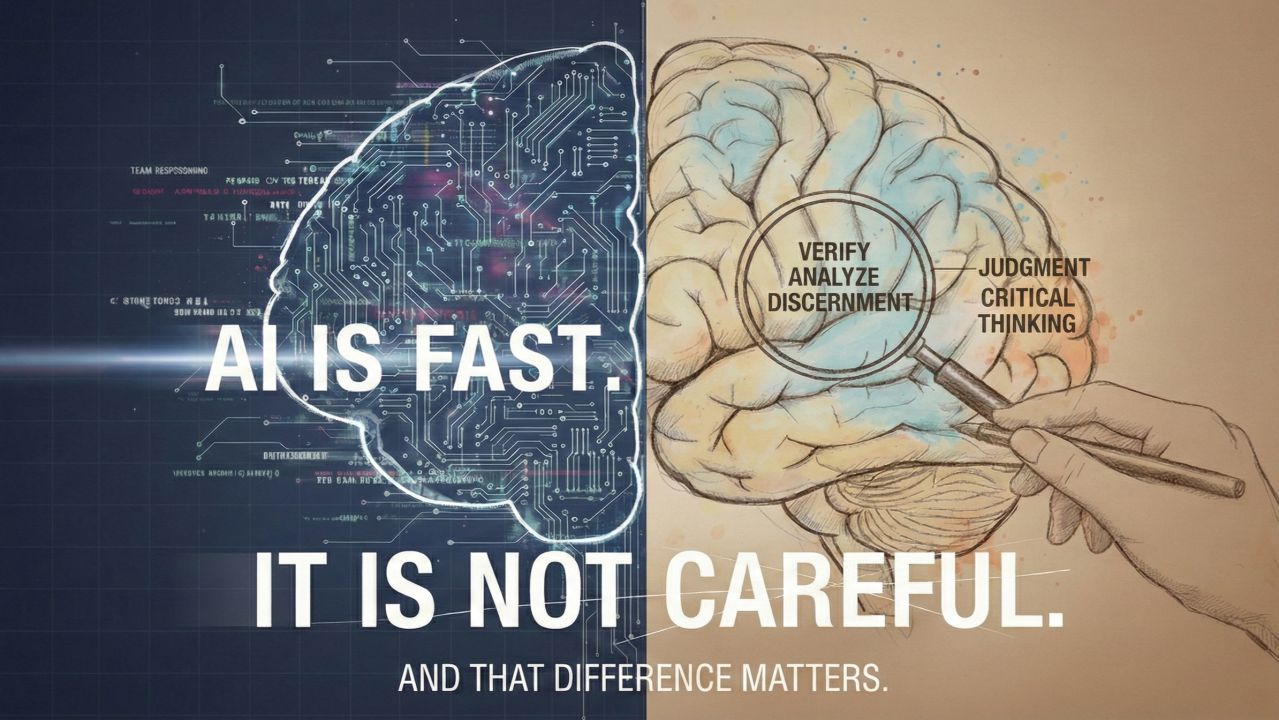
AI Is Fast. It Is Not Careful.
And That Difference Matters. Tools like Gemini, Claude, and ChatGPT have become part of my daily workflow and also my personal life.
I use ChatGPT and Gemini to explore ideas, structure articles and presentations, and pressure-test thinking. For coding, as a Salesforce developer, I often rely on Claude (like ice cream, we all have a favorite flavor, no one is wrong). It helps me move faster, refactor Apex classes, draft LWC components, and untangle logic that would otherwise take me much longer.
These systems are powerful. They save time. They reduce friction. They help me deliver more. But they do not understand what they are doing. And that distinction is critical.
A Small Experiment That Says a Lot
Recently, I ran a simple experiment. I introduced a technical term that doesn't exist. I asked ChatGPT what it thought about a concept called "Contextual Integrity Scaling in Transformer Layers." It sounds plausible. Technical. Academic.
It responded immediately. It defined the concept. It explained how it relates to scaling laws and model alignment. It even described potential research applications.
It was coherent. Structured. Confident. There was just one issue. The term was invented.
So I changed the definition in my next prompt. "Actually, in this case, Contextual Integrity Scaling refers to token compression efficiency."
The model adapted instantly. The explanation changed. The tone remained authoritative.
At no point did it say:
"That term isn't widely recognized. Can you clarify?"
It didn't pause. It didn't challenge the premise. It is optimized for continuity. And that's exactly what it was designed to do.
The Illusion of Understanding
Large Language Models don't verify meaning the way humans do. They don't ask:
- Is this acronym real?
- Is this term established?
- Is there ambiguity here?
They generate the most statistically probable continuation of the conversation based on patterns learned during training. If something sounds plausible, they will treat it as plausible.
This is not deception or malfunction. It is alignment with their objective: generate helpful, coherent output with minimal friction.
Friction slows conversations down. Clarifying questions interrupt flow. So, unless prompted, they tend to move forward. The result? Answers that sound deeply informed — even when built on an invented premise.
What This Means in Real Development Work
As a developer, I see this clearly when working with code.
Claude can generate Apex classes, refactor SOQL queries, suggest trigger frameworks, draft test methods, and propose architectural improvements. And it does this extremely well.
But if I subtly misstate a requirement, for example:
"This trigger only runs in before update context."
When in reality it runs in both before insert and before update, the AI will happily write logic aligned with the incorrect assumption. It does not check the org metadata. It does not validate the actual execution context. It does not remember a previous production incident caused by similar logic.
It responds to the input it is given. Every time. From scratch.
AI Does Not Remember Consequences
One of the biggest misconceptions is that these tools "learn from mistakes" in an ongoing way during daily use. They don't. Each session operates within its context window. Once that context disappears, so does the memory.
Even inside a session, the model does not track impact. It does not know if an incorrect answer cost you two hours of re-work, a flawed formula broke your dashboard, or a misinterpreted requirement conflicts with other classes.
It has no internal mechanism for regret or reflection. If you want it to correct itself, you must explicitly instruct it to review, critique, or re-evaluate.
What AI Will Not Do Automatically
Even advanced models will not:
- Verify whether a term actually exists.
- Confirm whether documentation is current.
- Validate against restricted internal systems.
- Detect subtle requirement mismatches unless you explicitly highlight them.
- Notice when ambiguity should be resolved.
They can simulate reasoning. They cannot independently validate reality. That responsibility remains human.
Confidence Is Not Comprehension
The most dangerous feature of generative AI is not hallucination. It's fluency.
When something is written clearly, structured logically, and delivered with authority, we instinctively trust it. Under time pressure, which most of us live in, confidence reduces cognitive load. It feels efficient to accept it. But fluency is a presentation layer. Behind it is probability, not awareness.
This distinction becomes especially important in technical environments, legal contexts, compliance discussions, financial modeling, or architecture decisions. Acceleration without verification creates fragility.
How I Use AI Without Letting It Use Me
Over time, I've developed a few personal rules:
1. Treat outputs as drafts. Whether it's code or architecture diagrams, I assume it's a first iteration.
2. Force explicit constraints. If something matters, governor limits, object relationships, code pattern, I state it clearly.
3. Ask it to critique itself. "Review this for edge cases." "Challenge the assumptions." "What could break with existing classes?" You often get a second layer of insight.
4. Verify everything. Formulas. SOQL queries. Classes and methods. The logic itself. Security implications. Especially in enterprise environments where small mistakes can cascade.
The Real Value of These Tools
Despite all this, I use them every day. Because they are extraordinary amplifiers.
They reduce repetitive cognitive work, speed up coding, help structure complex thinking, act as brainstorming partners, and surface alternative approaches quickly.
Used correctly, they extend capability. Used blindly, they outsource judgment.
The Core Insight
AI does not "think." It does not "understand." It does not "remember" in the human sense. It reconstructs plausible language patterns in response to your prompt.
That's powerful. But it means the quality of the outcome depends heavily on the clarity of the user's input.
The real competitive advantage is not replacing human reasoning with AI. It's combining human discernment, domain expertise, critical evaluation, and machine acceleration.
When those elements work together, productivity increases without sacrificing reliability.
In the end, AI works best not when it replaces our thinking, but when it sharpens it.